Free Cloud Hosting Credits (2026): Google $300, AWS $200, Azure $200
The three big clouds all give new customers free hosting credits, but each runs out on a clock. Google Cloud gives $300 to spend within 90 days, AWS up to $200 over six months, and Azure $200 to use within 30 days, as listed on their own pages on 18 Oct 2026. Credits suit a developer testing an app or a server. For an ordinary website they're a short trial, not free hosting, and a small always-free allowance is what remains when the credit ends.
Use credits if you want to learn a cloud platform, prototype something, or run a short project with a firm end date. Don't build a long-lived site on them unless you've priced what it costs once the credit is gone. Below are the terms of each offer, what happens on the last day, and the ways to earn more credit.
The three main free credit offers
| Provider | Credit | Time limit | When it ends | Always-free extras |
|---|---|---|---|---|
| Google Cloud | $300 | 90 days from signup | Projects stopped unless you upgrade to a paid account | Free Tier, incl. 1 e2-micro instance a month |
| AWS | $100 at signup + up to $100 earned | 6 months | Free-plan account closes at 6 months or when credit runs out | Varies by service |
| Microsoft Azure | $200 | 30 days | Move to pay-as-you-go to continue | 20+ services free monthly for 12 months, some always free |
Google's Free Trial applies only if you've never been a paying Google Cloud, Maps Platform or Firebase customer and haven't had the trial before, and it needs a valid card or other payment method at signup. AWS's newer Free Tier adds $100 when you open the account and lets you earn up to $100 more by trying key services. Azure may place a temporary $1 authorisation on your card during verification, which it reverses.
How fast each credit has to be used
The headline amounts aren't comparable on their own, because the clocks differ so much. Dividing each credit by its time limit shows how quickly you'd need to spend to use all of it, and how much is likely to expire unused on a small project.
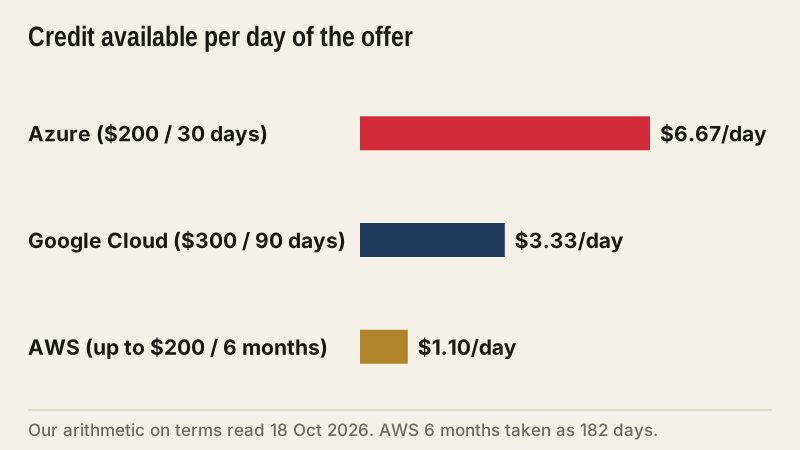
A small website or test server uses a few dollars a month. For reference, DigitalOcean's smallest Droplet lists at $4 a month and a 1 GiB Droplet at $6 (read 18 Oct 2026). At that scale none of these credits gets close to running out before its clock does. That makes the time limit, not the dollar figure, the real terms of the offer for most people. The credits only feel generous for heavier work such as databases, AI services or larger servers.
What happens on the last day
This is where free credit turns into a bill or a lost project, so read it before you build. Google says that if you don't upgrade to a paid billing account before the 90 days pass, or you spend the full $300, the trial billing account closes and its projects and resources are stopped. If you do upgrade early, the trial ends but you keep any unused credit until the 90-day mark, and the Free Tier continues.
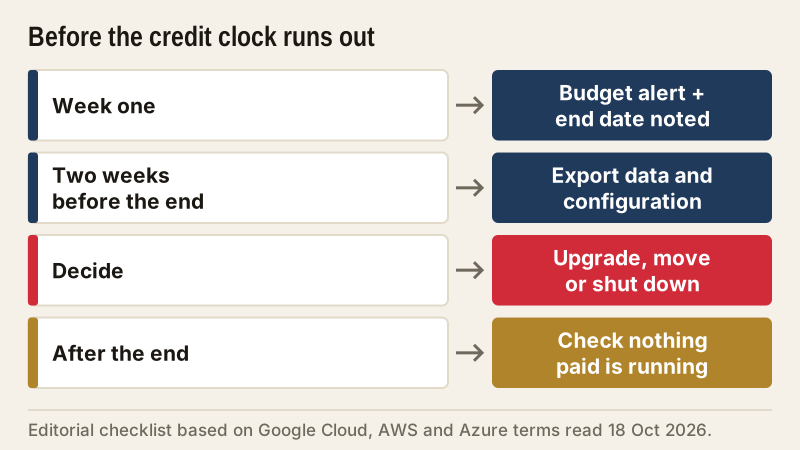
AWS's free-plan account closes on its own six months after you open it, or sooner if the credit is used up, and it won't charge you unless you convert to a paid plan. Azure's page says to move to pay-as-you-go to continue beyond 30 days or after the credit is used. In each case, decide before the deadline whether the project moves to paid hosting, gets exported, or ends.
Who free credits really suit
Credits are designed to get developers building on a platform, and they reward people who arrive with a plan. If you know what you want to test, such as a container, a managed database or an AI service, a month or three of free usage is a genuine saving and a low-risk way to learn the console. If you just want somewhere to put a WordPress site, the credit mostly buys you a crash course in cloud billing.
The best candidates are students and career-changers learning cloud skills, developers prototyping an app before choosing a host, and small teams load-testing an idea with a fixed end date. The worst are site owners hoping the credit will quietly carry a live site, because the end date arrives whether the site is ready to move or not.
Ways to earn more free credit
Beyond the signup offers, credit comes from a handful of programs. Each has eligibility rules, and none turns credit into permanent free hosting.
- AWS's built-in extra $100. The new Free Tier pays up to $100 more as you explore key services, on top of the $100 at signup.
- Referral programs. DigitalOcean listed $25 for the referrer once a referred customer has spent $25 (read 9 Oct 2026). It's earned credit, but only after someone else pays.
- Nonprofit grants. AWS offers up to $5,000 in credits through TechSoup, in tiers valid for 12 months, and Microsoft lists a $2,000 yearly Azure grant for eligible nonprofits.
- Student and startup programs. These offer larger credits with eligibility checks; our student and startup discounts guide covers what's real.
Be wary of sites promising to "earn free hosting credits" by completing tasks or watching ads. Credits that matter come from the cloud provider, or a partner it names on its own site, after a signup or eligibility check. Our coupon code reality check explains why third-party offers rarely add anything.
Credits or a cheap paid plan?
For a normal website, a low-cost shared plan usually beats juggling cloud credits. You get a control panel, email and support, and you know the renewal price before you start. For an app, a database or a learning project, credits are the better deal, because the free period lets you try a real platform at no cost. Either way, compare on what you'll pay after the free period. Our web hosting deals ranking does that for shared plans, and the renewal cliff explainer shows why the second bill matters most.
Edge cases
- You've used the trial before. Google's Free Trial is for customers who haven't signed up for it before, so plan to use it once, well.
- Limited products. Google says access to some products may be limited during the trial; check before you design around one.
- Credits and taxes. Paid usage after credits can carry tax depending on your country.
- Team accounts. Credits attach to the billing account, so use an organisation account if the project isn't personal.
Free cloud credit questions, answered
How do I get free hosting credits?
Can I host a website for free with cloud credits?
What happens when Google Cloud's $300 credit runs out?
Does AWS charge you after the free credits?
How can I earn more cloud credits?
See how the current deals really compare: the best web hosting deals, ranked by true cost, or the Black Friday hosting deals worth waiting for.