Web Hosting for Nonprofits (2026): Free Plans and Credits That Are Real
The best web hosting deal for a nonprofit in October 2026 is a program that cuts the price you keep paying, not a first-year promo. For a registered US charity with a simple site, Kualo's free Charity Solo plan is the clearest offer we could confirm on a host's own page. Bigger needs are better served by the cloud grants: AWS credits worth up to $5,000 a year through TechSoup, and $2,000 a year in Azure credits. Google and Microsoft also run nonprofit programs for email and documents.
One warning before you shortlist anything. Many "best hosting for nonprofits" lists still name a free DreamHost plan for 501(c)(3) groups, but DreamHost's nonprofits page returned a 404 error when we checked on 10, 18 and 26 October 2026. We list only programs we could read on the provider's own site, with the date. Eligibility rules change, so confirm before you apply.
Nonprofit hosting programs we could verify
| Program | What you get | Who qualifies | Strings attached | Checked |
|---|---|---|---|---|
| Kualo Charity Solo | Solo shared plan free (normally $11.49/mo); up to 50% off bigger plans | Small US 501(c)(3)s listed on Charity Navigator | Domain with Kualo; small footer link | 18 Oct 2026 |
| AWS Nonprofit Credit Program | $1,000, $2,000 or $5,000 in credits, valid 12 months | Eligible nonprofits via TechSoup | One grant per fiscal year | 10-18 Oct 2026 |
| Microsoft Azure grant | $2,000 in Azure credits per year | Eligible nonprofits | Cloud services, not shared hosting | 10 Oct 2026 |
| Google for Nonprofits | Nonprofit editions of Google products | Charities verified by Goodstack | Excludes government, hospitals, schools | 18 Oct 2026 |
| Cloudflare Project Galileo | Free Cloudflare security protection | Human rights, civil society, journalism, democracy groups | Application required | 18 Oct 2026 |
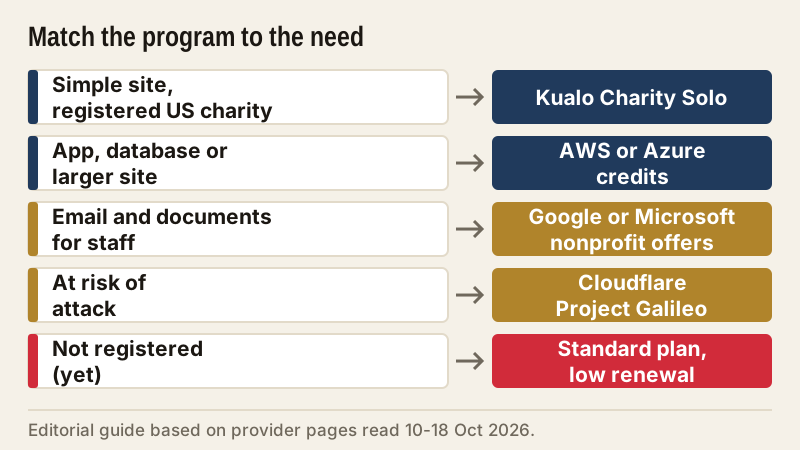
These fall into two kinds. Kualo's offer is ordinary shared hosting at no charge, which suits a brochure site, a donation page and a few mailboxes. The cloud grants are credits against usage, which suit an organisation with a developer or an agency partner. A volunteer-run charity rarely needs both.
Kualo: a free shared plan for US charities
Kualo's charity page says it gives registered USA charities its entry-level Solo plan free, or at a 50% discount, and up to 50% off its larger plans. The free plan supports one website with subdomains, up to 10 email accounts, five MySQL databases and 10 GB of NVMe storage, with free SSL and LiteSpeed caching, and Kualo puts its capacity at around 100,000 page views a month. In return it asks for two things: register or transfer your domain with Kualo, and add a small text link to its charity page in your site footer. It says it has supported more than 1,000 charities. The fine print matters: you need to be a 501(c)(3) listed on Charity Navigator with an IRS determination letter, and the free plan is not offered to, among others, schools, universities, local branches of larger charities, non-secular charities, or charities with annual income above $500,000; those are generally offered the 50% discount instead.
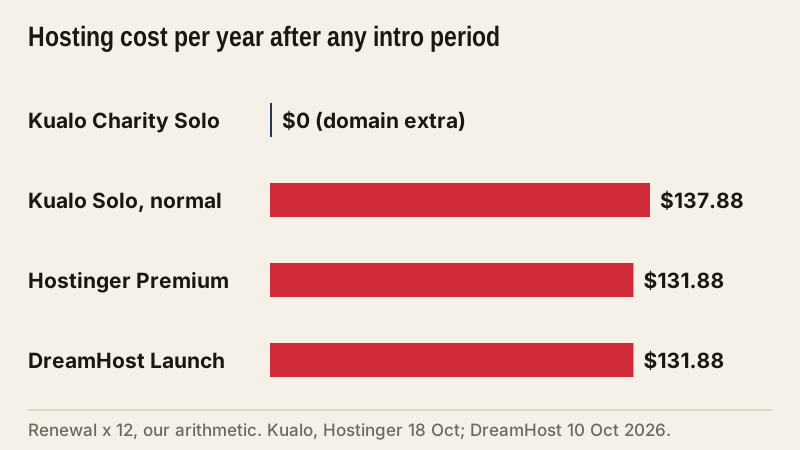
That's a real saving. Kualo lists Solo at $11.49 a month normally, which is $137.88 a year by our arithmetic, and a free plan avoids the renewal cliff that makes most cheap hosting deals expensive in year two. You do pay for the domain, since a domain always costs someone something. Kualo isn't one of our affiliate partners, so there's no link here; search for its charity hosting page directly.
Cloud credits: AWS and Azure
If your nonprofit runs an app, a database or a larger site, the cloud grants are worth far more than a free shared plan. AWS's Nonprofit Credit Program offers up to $5,000 in promotional credit, applied for through TechSoup. TechSoup lists three sizes, $1,000, $2,000 and $5,000, each valid for 12 months, and AWS limits it to one grant per fiscal year running July to June. Microsoft lists an annual Azure grant of $2,000 in credits for eligible nonprofits (read 10 Oct 2026).
Credits are not hosting. Someone has to build and run the servers, set budgets and alerts, and plan for the day the credit year ends. When it does, you pay normal usage rates on whatever is still running. The pattern is the same one behind student and startup discounts: a generous start, then the standard price.
Email, documents and security
A charity's website is usually the smaller cost. Email and shared documents add up faster, and both Google and Microsoft run nonprofit programs. Google for Nonprofits requires verification through its partner Goodstack and excludes government bodies, hospitals and healthcare organisations, and schools and universities, which go to Google for Education instead. Microsoft's offers page listed no-cost Microsoft 365 Business Basic licences for nonprofits, capped at 300 users, when we read its offers page on 10 Oct 2026.
For organisations at risk of attack, Cloudflare's Project Galileo gives free security protection to groups working in human rights, civil society, journalism or democracy. It's an application, not a sign-up, and it protects a site you host elsewhere. Pairing it with a modest host is often a better deal than paying for a premium security tier.
How to apply without losing a month
Nonprofit programs are slower than a checkout page, because someone has to confirm your status. A little preparation keeps the gap between applying and launching short.
- Gather your proof of status first: for US charities, the IRS determination letter, plus the organisation's legal name and address exactly as registered.
- Create a shared organisation email address and use it for every application, so approvals don't land in a departed volunteer's inbox.
- Apply for the program that matches your biggest cost first; for most small charities that's email and documents, not the website.
- Launch the site on whatever you have while you wait, and move it once the free plan or credits are approved. A small site moves in an afternoon.
- Record each approval date, renewal or re-verification date and expiry in one shared document.
If you don't qualify (yet)
Plenty of community groups, clubs and new charities aren't registered, or are registered outside the US. For them the nonprofit programs above don't apply, and the usual deal rules do. Judge a plan by what it renews at rather than what it opens at, and prepay only as long as you're confident the group will run the site. A volunteer committee changes every year or two, so a three- or four-year prepay can outlast the people who bought it.
Put the hosting and the domain in an organisation email account rather than a volunteer's personal one, and record the renewal date where the next treasurer will find it. Our renewal cliff guide explains why year two costs more, and our web hosting deals ranking scores current offers on total cost over the term.
Edge cases
- Coupon sites offering "nonprofit codes". Real nonprofit pricing comes from the provider after a status check, not from a code. See what hosting coupon codes really do.
- Shared hosts with nonprofit discounts on request. Some hosts quote a rate if you email sales with proof of status. Ask whether it applies at renewal, and get it in writing.
- Annual re-verification. Grants and credits can require renewed proof of status each year. Diarise it.
- Footer-link conditions. Kualo's free plan asks for a small text link in your footer. Check that your board is comfortable with it.
Nonprofit hosting questions, answered
Is there free web hosting for nonprofits?
Does DreamHost still offer free hosting for nonprofits?
What is the AWS nonprofit credit?
Do nonprofits get free email?
What should a small charity look for in hosting?
See how the current deals really compare: the best web hosting deals, ranked by true cost, or the Black Friday hosting deals worth waiting for.